
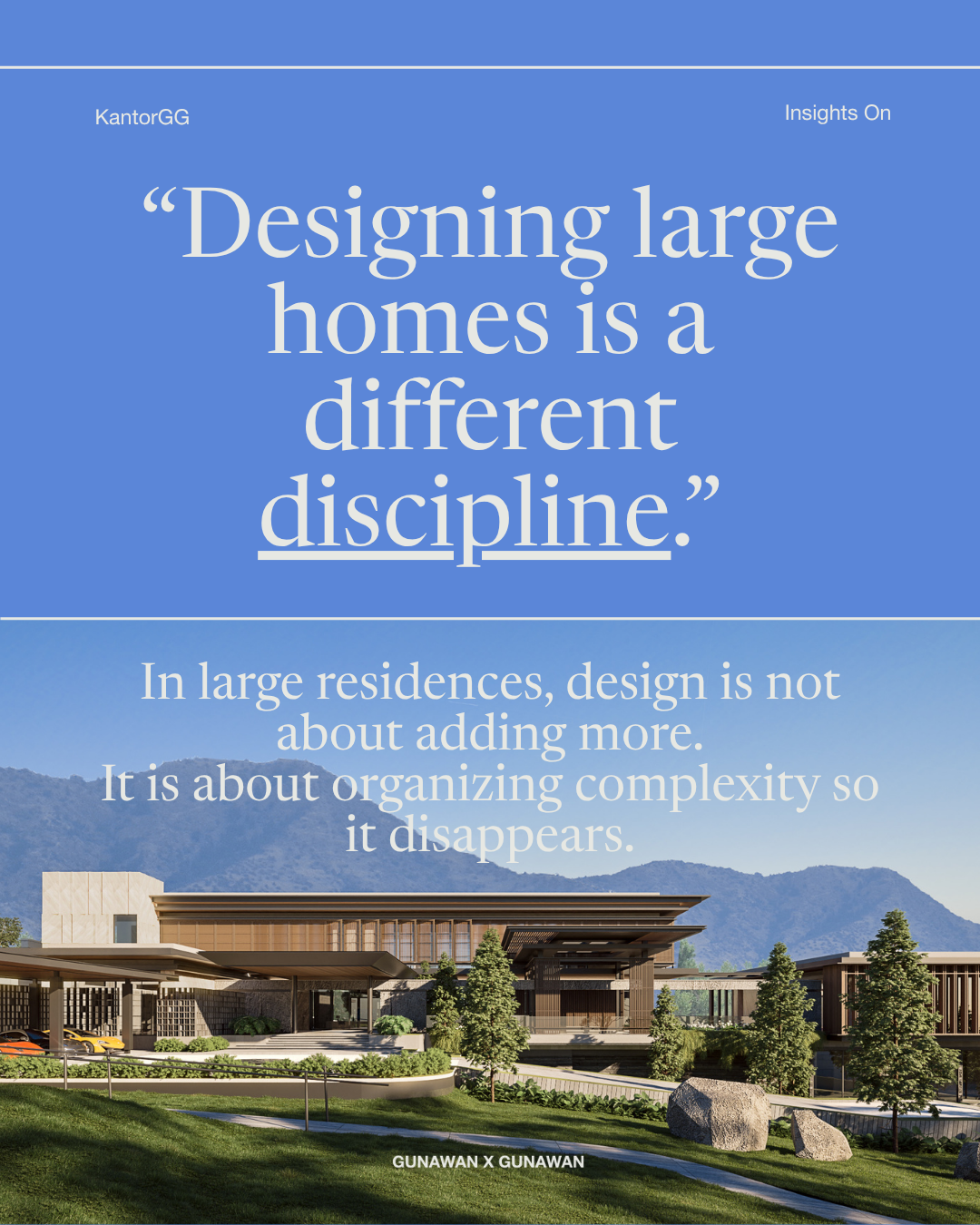
Designing Large Homes Is a Different Discipline
In luxury residential architecture, scale changes everything.
A large residence is not simply a bigger house. It is an entirely different design discipline, one that demands far more than aesthetics alone. As homes increase in scale, design shifts from arranging rooms to orchestrating systems. What appears effortless on the surface is often the result of immense coordination beneath it.
At KantorGG, we believe the true challenge of designing large residences is not about adding more space, more materials, or more visual impact. It is about organizing complexity so seamlessly that it disappears.
In smaller homes, many decisions can rely on intuition alone. But in large residences, complexity multiplies rapidly. The relationship between public spaces, private areas, staff operations, circulation, entertainment, and long-term living conditions becomes increasingly intricate. Without a clear underlying structure, even visually impressive homes can begin to fail experientially. Movement overlaps. Privacy dissolves. Spaces become inefficient despite their size.
This is why large residences demand systems thinking.
One of the most critical principles in designing expansive homes is the separation between public, private, and service zones. A successful residence must allow guests to move intuitively through entertaining spaces while enabling owners to maintain complete control over their privacy. Simultaneously, staff operations must function discreetly in the background without interrupting either. When these layers are not properly resolved, the home slowly loses its sense of calm.
Luxury is not simply visual. Luxury is clarity.
Circulation therefore becomes one of the most powerful tools in residential architecture. Who moves where, how they arrive, what they encounter first, and what remains concealed all shape the emotional experience of the house. In large residences, circulation is not merely about connecting spaces. It is about choreographing experiences. Guests should feel naturally guided through the home without hesitation. Owners should feel protected from exposure. Staff should operate seamlessly and efficiently. When circulation is designed well, the home feels effortless despite its complexity.
Large homes also require psychological zoning. Not every space is meant to be shared. Some spaces are designed for gathering, entertaining, and openness, while others must support solitude, focus, retreat, and emotional rest. Without this balance, homes can become visually impressive yet emotionally exhausting. A residence should be capable of hosting generously while still preserving intimacy and withdrawal when needed.
Scale itself is equally unforgiving. What feels balanced in smaller homes often collapses at a larger scale. Ceiling heights, material transitions, furniture composition, lighting, acoustics, and visual rhythm all become magnified. Too little detail creates emptiness. Too much detail creates noise. Large residences therefore demand an extraordinary level of precision in proportion and restraint. The goal is not to overwhelm the occupant with scale, but to create expansiveness that still feels grounded, warm, and human.
Beyond aesthetics, large homes must also be designed for time. A successful residence should not only photograph beautifully upon completion. It must continue to support daily life years into the future. The architecture must accommodate changing routines, evolving family dynamics, hosting, maintenance, privacy, and long-term adaptability without losing coherence. Enduring homes are not built around trends. They are built around human behavior.
Not all homes should be large. But when they are, they require a fundamentally different way of thinking. Designing at this scale is not about excess. It is about clarity at scale creating homes that feel calm despite complexity, private despite openness, and effortless despite the immense coordination behind them.
This is the discipline behind truly exceptional residential architecture, and it is the philosophy that guides our approach at KantorGG.


CONTACT